
Extraordinary Attorney Woo (이상한 변호사 우영우): The Guide
The drama that became a global sensation by being, quietly and precisely, about what it means to see the world differently.
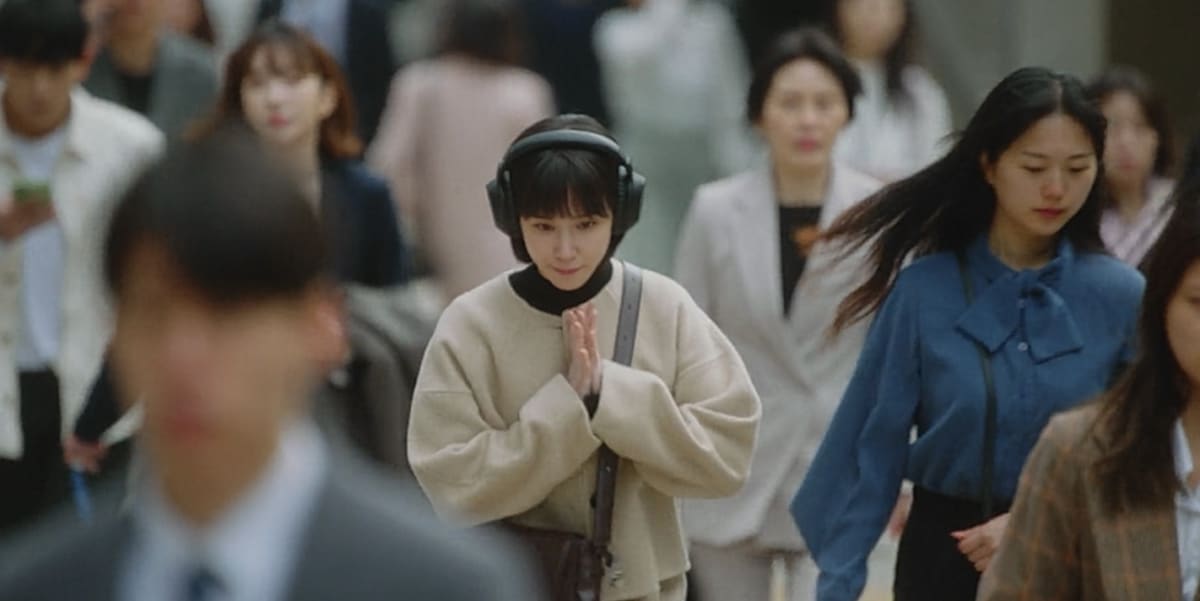
Extraordinary Attorney Woo arrived in the summer of 2022 and became one of Netflix's most globally watched non-English dramas in the platform's history. The premise — an autistic lawyer at a Seoul law firm — could easily have been sentimental, patronising, or exploitative. What the drama is instead is something more interesting: an accumulation of small precise observations about how a specific kind of mind navigates a world that wasn't built for it, delivered with enough warmth and enough honesty to feel genuinely rare.
The Story
Woo Young-woo (Park Eun-bin) is a newly hired associate at Hanbada, a mid-sized Seoul law firm. She graduated first in her class from Seoul National University's law school, passed the bar with a perfect score, and has an extraordinary memory and an exceptional legal mind. She is autistic and is encountering the ordinary workplace for the first time.
The drama is structured around legal cases — each episode or pair of episodes follows a single case — while building the arc of Young-woo's adaptation to the firm, her relationships with colleagues, and her developing feelings for a junior colleague named Jun-ho (Kang Tae-oh).
The Cast
Actor | Character | Note |
|---|---|---|
Park Eun-bin | Woo Young-woo | One of the finest performances in recent Korean drama |
Kang Tae-oh | Lee Jun-ho | Young-woo's colleague; the central romance; military service interrupted his career at the show's peak |
Kang Ki-young | Jung Myung-seok | Young-woo's supervising attorney; the father figure who believes in her |
Ha Yoon-kyung | Choi Su-yeon | Young-woo's colleague; the friendship arc that grounds the show |
Baek Ji-won | Kwon Min-woo | The competitive colleague whose resentment provides the drama's conflict |
Park Eun-bin's performance is the drama's foundation and its reason for success. She plays Young-woo with specific, consistent physical and cognitive detail — the way she moves, processes, waits, responds — without reducing autism to a list of traits. The performance is a portrait of a particular person, not a condition. It was widely praised by autistic viewers and disability advocacy organisations, though not without some criticism about the specific portrayal choices.
The Whales
Young-woo loves whales. She talks about them at length, to people who didn't ask, in contexts where the information is not relevant. The whale passion is both a character detail and a structural device: periodic animated sequences visualize the connection between a legal concept and a whale behavior, providing the drama's most visually distinct moments.
The whale sequences are not everyone's preference. Some viewers find them charming and integral; others find them affected. They are, either way, central to the show's visual identity.
What the Drama Does Well
The legal cases as ethical questions. Each case in EAW is structured around a genuine ethical or social tension — disability accommodation, environmental rights, land development vs. community welfare, inheritance disputes within blended families. Young-woo's legal thinking — often arriving at the solution by an unexpected angle — is consistently plausible and satisfying. The drama takes law seriously as a subject, not just as backdrop.
Young-woo as a character, not a symbol. The drama is careful not to use Young-woo to demonstrate that autism is actually a superpower, or that neurodivergent people are secretly gifted. Young-woo has an exceptional memory and specific abilities, but she also faces real difficulties — social navigation, workplace dynamics, romantic communication — that the drama doesn't paper over. The challenges are present alongside the abilities.
The relationships. Young-woo's friendships — particularly with Su-yeon and with her colleague Dong Geu-ra-mi — are developed with genuine care. Her relationship with her father is one of the drama's quieter emotional cores. The romance with Jun-ho is the most conventionally K-Drama element, but Park Eun-bin and Kang Tae-oh's chemistry makes it work.
Tip — The revolving door: One of the drama's recurring devices is Young-woo's difficulty entering the office through a revolving door. Various characters help her in different ways across the series. The device functions as a running indicator of relationship — how different people respond to her specific difficulty reveals their character more economically than any amount of dialogue.
The Limitations
Extraordinary Attorney Woo is excellent television that has also attracted honest criticism:
The autism portrayal is specific to one presentation. Young-woo's presentation — exceptional memory, specific intense interest, social navigation difficulty — represents one pattern within the autistic spectrum, and the drama has been criticized for presenting it as representative. Autistic viewers have reported both strong identification and significant distance from the portrayal.
The legal cases simplify. Korean law is depicted in an accessible rather than accurate way — the drama uses cases to raise ethical questions, not to accurately depict legal procedure. This is a feature rather than a bug from an entertainment perspective, but viewers interested in Korean law for professional reasons should be aware.
Season 2. A second season aired in 2024. Critical reception was more divided — some felt it recaptured the original's spirit; others found it uneven. The first season is complete in itself.
Why It Went Global
Extraordinary Attorney Woo became one of the most discussed K-Dramas of its era for a reason that isn't reducible to quality alone:
The drama arrived at a moment when autism representation in mainstream entertainment had become a significant cultural conversation globally, and it offered something most similar projects hadn't — a portrait that was specific, warm, and produced by a culture that approaches the subject differently from American or European productions. Korean drama's specific relationship with outsider figures (the person who doesn't fit the system is frequently its protagonist) created a natural home for Young-woo's story.
Key Facts
Network | ENA (also Netflix) |
Year | 2022 |
Episodes | 16 |
Where to watch | Netflix |
Writer | Moon Ji-won |
Director | Yoo In-shik |
Comments
Inappropriate comments may be deleted.
Log in to leave a comment.
No comments yet. Be the first!