
Hangul (한글): Basic Consonants and Vowels
Learn the 10 vowels and 10 consonants that unlock hundreds of Korean syllables.

Here's a fact that might surprise you: most people can learn to read Hangul — the Korean alphabet — in about an hour. Not understand it, but actually sound out the letters. That's because King Sejong (Se-jong-dae-wang), who created Hangul in 1443, had one goal above all else: make it easy for everyone.
At the time, Korea used Chinese characters, which took years to master. Ordinary people who couldn't read had no way to defend themselves in legal disputes or understand official documents. King Sejong designed Hangul from scratch so that anyone — regardless of age or background — could learn it in days.
The secret? Hangul is a building-block system. Every syllable is one compact square, built by snapping consonants and vowels together. Once you learn the blocks, you can read anything.
Tip — About Romanization: Throughout this book, Korean words are written with English letters to guide your pronunciation. This is called Romanization. We've also added hyphens between syllables (e.g., Se-jong-dae-wang) to make words easier to sound out. Use it as a training wheel — the goal is to read the real Hangul eventually.
1. The 10 Basic Vowels
Korean vowels were built from three shapes found in nature: the sky (ㆍ — a dot), the earth (ㅡ — a flat line), and a person (ㅣ — a standing line). Every vowel in Korean comes from combining these three elements.
Memorize these 10 in order — this is exactly how Korean children first learn them:
ㅏ ㅑ ㅓ ㅕ ㅗ ㅛ ㅜ ㅠ ㅡ ㅣ
Vowel | Sound | Closest English Sound |
|---|---|---|
ㅏ | a | the "a" in father |
ㅑ | ya | the "ya" in yard |
ㅓ | eo | the "uh" in uh-oh |
ㅕ | yeo | the "yuh" in young |
ㅗ | o | the "o" in go |
ㅛ | yo | the "yo" in yo-yo |
ㅜ | u | the "oo" in moon |
ㅠ | yu | the "you" in you |
ㅡ | eu | say "uh" with your lips spread flat — no rounding |
ㅣ | i | the "ee" in see |
Tip — Spot the pattern: ㅏ, ㅓ, ㅗ, and ㅜ are the four "base" vowels. Add a small extra stroke to each one and a "y" sound appears automatically: ㅏ(a) → ㅑ(ya), ㅓ(eo) → ㅕ(yeo), ㅗ(o) → ㅛ(yo), ㅜ(u) → ㅠ(yu). That cuts your memorization in half.
2. The 10 Essential Consonants
Each Korean consonant was shaped to match the position of your mouth when you make that sound. ㅁ looks like lips pressed together — because that's exactly what you do to say "m." ㄴ curves like a tongue touching the roof of your mouth.
There are 14 consonants in total, but these 10 are the foundation:
ㄱ ㄴ ㄷ ㄹ ㅁ ㅂ ㅅ ㅇ ㅈ ㅎ
Consonants don't stand alone in Korean — they always pair with a vowel. The easiest way to learn them is with the vowel ㅏ attached:
가(ga) 나(na) 다(da) 라(ra) 마(ma) 바(ba) 사(sa) 아(a) 자(ja) 하(ha)
Swap ㅏ for ㅗ and you immediately get a whole new set of syllables:
고(go) 노(no) 도(do) 로(ro) 모(mo) 보(bo) 소(so) 오(o) 조(jo) 호(ho)
Consonant | Sound | Example |
|---|---|---|
ㄱ | g | go |
ㄴ | n | no |
ㄷ | d | do |
ㄹ | r / l | between road and load |
ㅁ | m | moon |
ㅂ | b | boo |
ㅅ | s | see |
ㅇ | (silent) | no sound when it starts a syllable |
ㅈ | j | joy |
ㅎ | h | hi |
Note on ㄹ: This is the trickiest consonant for English speakers. It's softer than the English "r" and lighter than "l" — somewhere in between. Think of the "tt" in the American pronunciation of "butter." With practice, it becomes natural.
3. Snapping Blocks Together
Now the fun part. Korean doesn't write letters in a row like English — it groups each syllable into one square block. Here's how the blocks are built:
NO! : ㅎ ㅏ ㄴ ㄱ ㅜ ㄱ
Yes! : 한국
Block Type 1 — Consonant + Vowel
The simplest block. One consonant, one vowel:
ㅎ + ㅏ = 하 (ha)
ㄱ + ㅜ = 구 (gu)
Block Type 2 — Consonant + Vowel + Consonant
A second consonant can sit at the bottom of the block. Koreans call this the batchim (받침), meaning "support." It slightly closes the syllable:
ㅎ + ㅏ + ㄴ = 한 (han) — like "ha" with the mouth gently closed by "n"
ㄱ + ㅜ + ㄱ = 국 (guk) — the "k" at the end closes with a soft stop
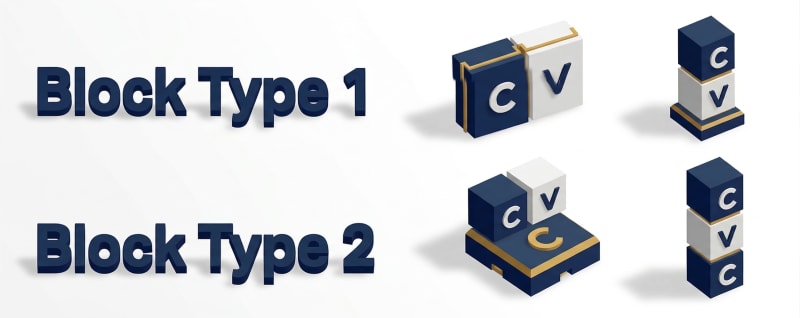
How the Blocks Are Arranged
The shape of the vowel determines the layout:
Vowels that stand tall (ㅏ ㅓ ㅣ etc.) → consonant goes left, vowel goes right
ㅎ + ㅏ = 하 (consonant | vowel, side by side)
Vowels that lie flat (ㅗ ㅜ ㅡ etc.) → consonant goes on top, vowel goes below
ㄱ + ㅜ = 구 (consonant on top, vowel below)
All four possible combinations:
Tall vowel | Flat vowel | |
|---|---|---|
No batchim | 하 ha | 구 gu |
With batchim | 한 han | 국 guk |
You're Already Halfway There
With 10 vowels and 10 consonants, you can now sound out hundreds of Korean syllables — including the word 한글 (Han-geul) itself:
한 = ㅎ + ㅏ + ㄴ
글 = ㄱ + ㅡ + ㄹ
There are a few more pieces to add: tense consonants, aspirated consonants, and compound vowels. They follow the same building-block logic — just more combinations. You'll find them all in the next article.
Comments
Inappropriate comments may be deleted.
Log in to leave a comment.
No comments yet. Be the first!