
Economic Power (경제 규모): Where It Stands in the World
The numbers behind the miracle — and what they actually mean.
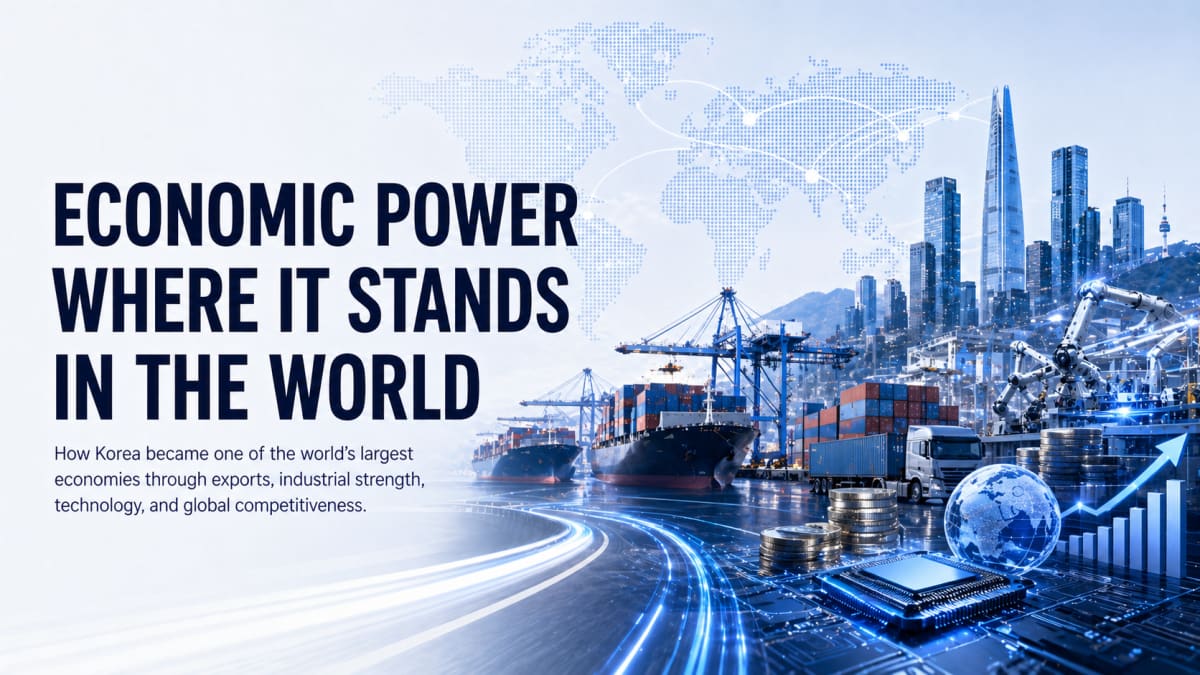
South Korea's economy is the 13th largest in the world by nominal GDP — ahead of Australia, ahead of Spain, roughly comparable to Russia and Brazil. For a country of 52 million people with no natural resources and a history of colonization and war, this position is extraordinary by any historical standard. Understanding what drives it, what sustains it, and what threatens it requires looking at the specific numbers.
GDP와 성장 (GDP and Growth)
South Korea's nominal GDP reached approximately $1.71 trillion in 2023. In purchasing power parity (PPP) terms — which adjusts for the cost of living — it is approximately $2.9 trillion, ranking 14th globally.
Per capita income has followed a comparable trajectory:
연도 (Year) | 1인당 GDP (Per capita GDP) |
|---|---|
1953 | $67 |
1970 | $279 |
1980 | $1,778 |
1990 | $6,610 |
2000 | $12,257 |
2010 | $23,087 |
2023 | ~$33,000 |
This curve — from $67 to $33,000 in 70 years — has no historical precedent at comparable scale.
Korea's GDP growth rate has moderated from the double-digit rates of the 1970s and 1980s to a more typical developed-economy range of 2–3% annually in recent years. This is not failure — it is the normal trajectory of a maturing economy. The challenge is maintaining competitiveness as labor costs rise and China and other emerging economies compete in sectors Korea previously dominated.
재벌 경제 (The Chaebol Economy)
One of the most distinctive structural features of the Korean economy is its concentration in large family-controlled conglomerates — 재벌 (chaebol). The top 10 재벌 account for approximately 68% of Korea's total stock market capitalization.
삼성 (Samsung) alone accounts for approximately:
20% of Korea's total exports
15% of Korea's stock market capitalization
Revenue equivalent to approximately 20% of Korea's GDP
This concentration creates structural risks. When Samsung performs poorly — as it did in 2023, when semiconductor prices collapsed — the impact on Korea's overall economic statistics is immediate and significant. Korea's economic fate is not diversified in the way that larger economies' fates are.
The top 5 재벌 by revenue:
순위 (Rank) | 그룹 (Group) | 주요 사업 (Core businesses) |
|---|---|---|
1 | 삼성 (Samsung) | Semiconductors, smartphones, displays, construction |
2 | 현대·기아 (Hyundai-Kia) | Automobiles, heavy industry, finance |
3 | SK | Energy, semiconductors, telecoms, batteries |
4 | LG | Electronics, chemicals, batteries, telecoms |
5 | 롯데 (Lotte) | Retail, food, chemicals, hotels |
Tip — 재벌의 구조 (How chaebol are structured): A 재벌 is not a single company — it is a network of legally separate companies linked through cross-shareholding and family control. Samsung Electronics (the chip and smartphone company), Samsung C&T (construction and trading), Samsung Life Insurance, and Samsung Heavy Industries are all distinct companies — but they share a family owner, a common brand, and interlocking shareholding structures that concentrate control. This structure has enabled rapid capital mobilization but creates governance problems that Korean corporate reform efforts have been trying to address for decades.
무역 구조 (Trade Structure)
Korea is one of the world's most trade-dependent major economies. Exports represent approximately 40% of GDP — a ratio that reflects both the success of export-led development and the vulnerability it creates.
주요 수출 대상국 (Top export destinations, 2023):
국가 (Country) | 비중 (Share) |
|---|---|
중국 (China) | 19% |
미국 (United States) | 18% |
베트남 (Vietnam) | 9% |
일본 (Japan) | 5% |
홍콩 (Hong Kong) | 4% |
China's position as Korea's largest export destination — and the fact that China is simultaneously Korea's most significant economic competitor in several sectors — creates a strategic tension that defines much of Korea's current economic policy debate. When Korea-China relations deteriorate politically, the economic exposure is immediate.
주요 수입 대상국 (Top import sources, 2023):
국가 (Country) | 비중 (Share) |
|---|---|
중국 (China) | 22% |
미국 (United States) | 11% |
일본 (Japan) | 8% |
호주 (Australia) | 6% |
사우디아라비아 (Saudi Arabia) | 5% |
Korea imports raw materials and energy — it has almost none of its own — and exports finished goods. This is the fundamental structure of its trade, and it has been remarkably consistent for decades.
노동 시장 (The Labor Market)
Korea's labor market reflects the tensions between its development model and the social expectations that model created.
실업률 (Unemployment rate): Approximately 2.5–3% — among the lowest in the OECD. But this figure masks significant underemployment and the structural divide between regular and non-regular workers.
비정규직 비율 (Non-regular employment): Approximately 38–40% of Korean workers — one of the highest rates in the OECD. Non-regular workers earn approximately 50–60% of regular workers' wages for comparable work, with fewer protections and benefits.
청년 실업 (Youth unemployment): Approximately 7–8% for those aged 15–29 — significantly higher than the headline rate, and accompanied by a large "not in education, employment, or training" (NEET) population.
노동 시간 (Working hours): Korea's average annual working hours of approximately 1,900 hours are among the highest in the OECD — significantly above the OECD average of approximately 1,700 hours. The gap between formal hours and actual culture of expected presence is even larger in certain sectors.
현재의 과제 (Current Economic Challenges)
저출산 (Low birth rate): Korea's total fertility rate of 0.72 (2023) is the lowest in the OECD. The demographic consequences — shrinking workforce, aging population, pension system stress — are among the most serious structural threats to Korea's economic position over the next 30 years.
가계부채 (Household debt): Korean household debt as a percentage of GDP is approximately 105% — one of the highest in the OECD. Much of this debt is concentrated in real estate, making the financial system sensitive to property price movements.
부동산 (Real estate): Seoul apartment prices relative to income are among the highest in the world. The median apartment price in Seoul exceeded 25 times annual median household income at the 2021 peak — a ratio that makes homeownership effectively impossible for most younger Koreans without family assistance.
Key Facts
명목 GDP (Nominal GDP) | Approximately $1.71 trillion (2023) — 13th largest globally |
PPP GDP | Approximately $2.9 trillion (2023) — 14th largest globally |
1인당 GDP (Per capita GDP) | ~$33,000 nominal / ~$50,000 PPP (2024) |
수출 의존도 (Export dependency) | Exports represent approximately 40% of GDP |
삼성 비중 (Samsung's weight) | Approximately 20% of total national exports |
상위 10대 재벌 (Top 10 chaebol) | Account for approximately 68% of total stock market capitalization |
비정규직 비율 (Non-regular employment) | 38–40% of Korean workers — among the highest in the OECD |
연평균 노동시간 (Annual working hours) | Approximately 1,900 hours — significantly above OECD average of ~1,700 |
합계출산율 (Total fertility rate) | 0.72 (2023) — lowest in the OECD |
가계부채 비율 (Household debt to GDP) | Approximately 105% — one of the highest in the OECD |
Comments
Inappropriate comments may be deleted.
Log in to leave a comment.
No comments yet. Be the first!