
Food Culture (음식 문화): More Than Just What You Eat
There's a reason the first thing a Korean asks a stranger is "Have you eaten?"
"밥 먹었어요?" — "Have you eaten?" — is one of the most common greetings in Korean. Not "How are you?" Not "What's up?" The concern is whether you've had your meal. This isn't a literal question about food. It's an expression of 돌봄 (care), 관심 (concern), and 유대 (connection) — a cultural reflex that reveals how deeply food is embedded in how Koreans relate to each other. To understand Korean food culture, you have to start here: food is not merely what you eat. It is how you are with other people.
공동체 음식 문화 (Communal Dining Culture)
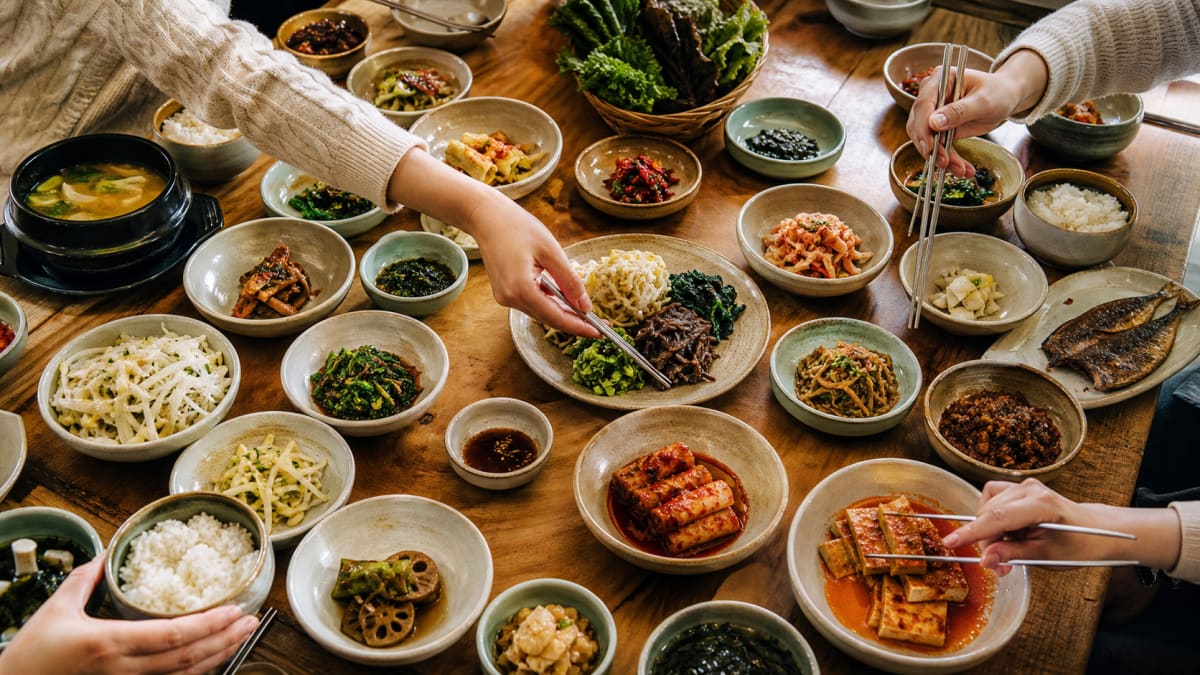
Korean food culture is fundamentally communal. The standard Korean meal structure — a main dish surrounded by multiple 반찬 (banchan, side dishes) shared from central plates — is not just a culinary format. It is a social architecture. Everyone reaches into the same dishes. Everyone eats together, from the same table, at the same pace.
반찬 문화 (Banchan Culture): 반찬 (banchan) are the small side dishes served alongside every Korean meal — 김치 (kimchi), 나물 (namul, seasoned vegetables), 두부 (tofu), 조림 (braised dishes), and dozens of others depending on region and season. At a restaurant, they arrive automatically and are refilled for free. At home, a meal without multiple banchan is incomplete. The variety and care put into banchan is a direct expression of 정성 (jeongseong, sincere effort) — particularly within family contexts.
The communal nature of Korean dining means that the Western concept of "my food" vs. "your food" doesn't translate cleanly. Sharing is the default. Eating alone from a separate plate when others are present would read as socially distant rather than politely independent.
김치 — 발효의 철학 (Kimchi: A Philosophy of Fermentation)
김치 (kimchi) is the most globally recognizable Korean food — and the most misunderstood. It is not a single dish. It is a fermentation method applied to dozens of vegetables: 배추 (napa cabbage), 무 (radish), 오이 (cucumber), 깍두기 (cubed radish), 열무 (young radish leaves), and more. The fermentation process produces lactic acid bacteria — the same beneficial bacteria found in yogurt — alongside complex 감칠맛 (umami) flavors that develop over weeks and months.
김장 (Kimjang) — the communal kimchi-making event held in late autumn before winter — was designated a UNESCO 인류무형문화유산 (Intangible Cultural Heritage) in 2013. Kimjang is a neighborhood or family event where large quantities of kimchi are made together for winter storage. It is simultaneously a food production activity and a social ritual — a way of maintaining community ties through shared labor.
Tip — 김치 먹는 법 (Eating Kimchi): Well-fermented and fresh kimchi taste completely different. Most foreigners first encounter 신김치 (aged, sour kimchi) and find it more challenging than the mild, fresh version. If you're trying kimchi for the first time, ask for 겉절이 (geotjeori, fresh kimchi salad) — less fermented and milder in flavor.
지역 음식 문화 (Regional Food Diversity)
Korean food is not monolithic. Regional variation is significant — shaped by climate, geography, and history.
지역 (Region) | 특징 (Character) | 대표 음식 (Signature Food) |
|---|---|---|
전라도 (Jeolla) | Most varied and abundant banchan; strong fermentation tradition | 전주 비빔밥 (Jeonju bibimbap), 홍어 (fermented skate) |
경상도 (Gyeongsang) | Saltier and spicier; direct, bold flavors | 밀면 (wheat noodles), 대구 탕 (Daegu-style soup) |
충청도 (Chungcheong) | Simple and mild; understated seasoning | 청국장 (fermented soybean stew), 올갱이국 (freshwater snail soup) |
제주도 (Jeju) | Seafood-centered; ingredients distinct from the mainland | 흑돼지 구이 (black pork BBQ), 옥돔국 (red tilefish soup) |
서울·경기 (Seoul/Gyeonggi) | Convergence of regional styles; influence of royal court cuisine | 설렁탕 (ox bone soup), 갈비 (short ribs) |
전라도 (Jeolla) cuisine — particularly 전주 (Jeonju) style — is widely regarded within Korea as the richest and most sophisticated. The region's agricultural abundance, combined with a strong fermentation tradition, produced a banchan culture of exceptional variety.
발효와 건강 (Fermentation and Health)
Korean food culture has a deep connection to fermentation that predates the global fermented foods trend by centuries. 김치 (kimchi), 된장 (doenjang, fermented soybean paste), 고추장 (gochujang, fermented chili paste), 간장 (ganjang, soy sauce), and 젓갈 (jeotgal, fermented seafood) are all fermented foods that form the base of Korean cooking.
These fermented foods are rich in probiotics, amino acids, and complex flavor compounds that develop through natural fermentation processes. The Korean diet's health profile — low in saturated fats, high in vegetables and fermented foods — has attracted sustained medical research attention, particularly in relation to gut health.
사찰 음식 (Temple Food)
사찰 음식 (temple food, Buddhist temple cuisine) represents a distinct strand of Korean food culture. Practiced by Buddhist 승려 (monks) and available to visitors at certain temples, temple food is vegetarian — excluding not just meat and fish but also 오신채 (the five pungent vegetables: garlic, green onion, wild chive, leek, and onion), which Buddhist tradition associates with desire and anger.
The cuisine emphasizes seasonal ingredients, fermentation, and minimal processing. International food culture professionals have recognized it as one of the most sophisticated vegetarian culinary traditions in the world. Temple food experience programs are available at 조계사 (Jogyesa Temple) in Seoul and various provincial temples.
Key Facts
"밥 먹었어요?" (Have you eaten?) | One of the most common Korean greetings — food as the language of care and connection |
반찬 (Banchan) | Shared side dishes served with every Korean meal; refilled for free at restaurants; an expression of 정성 (sincere effort) at home |
김치 (Kimchi) | A fermentation method applied to cabbage, radish, and many other vegetables — over 200 varieties exist |
김장 (Kimjang) | Communal late-autumn kimchi-making event — designated UNESCO Intangible Cultural Heritage in 2013 |
전라도 음식 (Jeolla cuisine) | Widely regarded within Korea as having the most abundant and varied banchan culture; particularly strong fermentation tradition |
발효 식품 (Fermented foods) | Kimchi, 된장 (doenjang), 고추장 (gochujang), 간장 (ganjang), 젓갈 (jeotgal) — the foundation of Korean cooking; rich in probiotics and amino acids |
사찰 음식 (Temple food) | Buddhist vegetarian cuisine excluding meat, fish, and the five pungent vegetables; recognized internationally as one of the world's most sophisticated vegetarian culinary traditions |
지역 다양성 (Regional diversity) | Jeolla, Gyeongsang, Chungcheong, Jeju, Seoul — distinct flavor profiles shaped by climate, geography, and history |
Comments
Inappropriate comments may be deleted.
Log in to leave a comment.
No comments yet. Be the first!