
Chimaek & Pojangmacha (치맥·포장마차): Korea's Street Food Scenes
Fried chicken and beer. Tteokbokki under an orange tent by the side of the road. Two things you can't leave out of any honest account of Korean street food culture.
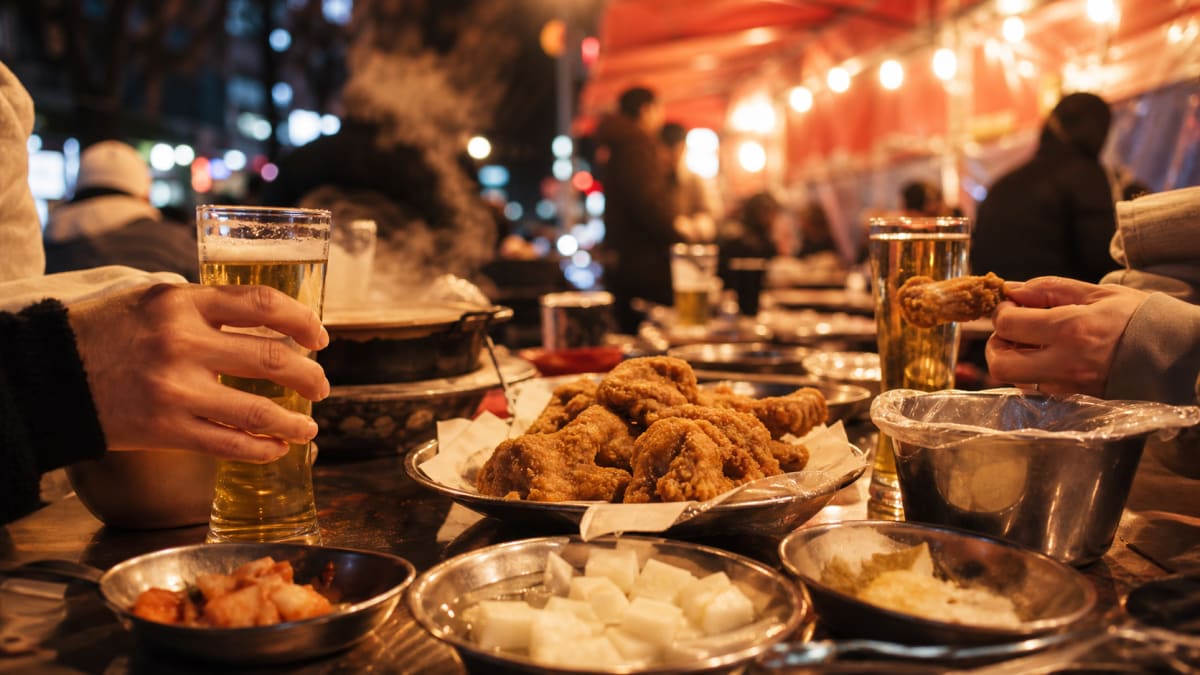
Some foods are just food. 치맥 (chimaek) and 포장마차 (pojangmacha) food are something more — they carry specific time, place, and emotion with them. 치맥 (chimaek) is what you have when watching 야구 (baseball), celebrating a promotion, or ending a long week with friends. 포장마차 (pojangmacha) is where you go late at night when a restaurant feels too formal and a convenience store feels too cold. Both are experiences as much as meals.
치맥 (Chimaek): 치킨 + 맥주
치맥 (chimaek) is a portmanteau of 치킨 (chikin, fried chicken) and 맥주 (maekju, beer). The combination is so standard in Korean food culture that it functions as a single concept — not just two items happening to be ordered together.
한국 치킨의 특징 (What Makes Korean Fried Chicken Different)
Korean fried chicken is distinct from Western fried chicken in technique and result. The key difference: 이중 튀김 (double frying). The chicken is fried once at a lower temperature to cook through, then fried again at a higher temperature to create an exceptionally thin, crispy crust. The result is skin that stays 바삭 (crispy) longer — including through 배달 (delivery).
소스 종류 (Sauce varieties):
종류 (Type) | 특징 (Character) |
|---|---|
후라이드 (Huraideu) | Plain — no sauce; pure crispiness |
양념 치킨 (Yangnyeom) | Coated in sweet-spicy 양념 (sauce) — the classic |
간장 치킨 (Ganjang) | Soy garlic glaze — savory, slightly sweet |
파닭 (Padak) | Topped with 파 (green onion) salad — cuts the richness |
허니 콤보 (Honey combo) | Half plain + half yangnyeom — the pragmatic choice |
치맥과 K-Drama (Chimaek in K-Drama)
치맥 (chimaek) culture was significantly amplified internationally by K-Drama. 별에서 온 그대 (My Love From the Star, 2013–14) featured a chimaek eating scene that went viral in China — triggering what became known as the "치맥 한류 (chimaek Hallyu)" as Chinese consumers began importing Korean chicken brands and traveling to Korea specifically for the experience. It is one of the clearest documented examples of K-Drama directly driving food exports.
치킨 배달 문화 (Chicken Delivery Culture)
Korea's chicken delivery culture is remarkable in its scale and speed. Korea has approximately 87,000 치킨 가게 (chicken restaurants) — more per capita than almost any other fast food category in any country. 배달의민족 (Baemin) and 쿠팡이츠 (Coupang Eats) list thousands of chicken restaurants, with average delivery times of 20–30 minutes. Ordering chicken for delivery at 11 p.m. on a Tuesday is completely normal.
Major chains: BBQ치킨 (BBQ Chicken), 교촌치킨 (Kyochon), BHC, 굽네치킨 (Goobne), 네네치킨 (Nene Chicken).
포장마차 (Pojangmacha): Street Food Under a Tent
포장마차 (pojangmacha, 布帳馬車) — literally "cloth-curtained horse cart" — refers to Korea's characteristic small street food stalls, typically covered with an orange or blue 천막 (tent) and equipped with plastic chairs and tables. They line 강변 (riverbanks), market alleys, and nighttime districts — serving hot food and 소주 (soju) or beer to late-night snack seekers.
포장마차 메뉴 (What to Eat)
음식 (Food) | 설명 (Description) |
|---|---|
떡볶이 (Tteokbokki) | Chewy rice cakes in spicy 고추장 (gochujang) sauce — the signature pojangmacha dish |
순대 (Sundae) | Pork intestine stuffed with glass noodles and vegetables — served with salt or tteokbokki broth |
어묵 (Eomuk / Odeng) | Fish cake skewers soaking in hot broth |
계란 (Gyeran) | Boiled eggs — simple and cheap |
라면 (Ramyeon) | Instant noodles cooked to order; egg addition common |
튀김 (Twigim) | Battered and fried items — sweet potato, squid, shrimp |
포장마차가 있는 곳 (Where to Find Pojangmacha)
Pojangmacha culture is alive throughout Seoul. Key areas:
청계천 (Cheonggyecheon): Along the stream running through central Seoul — especially active on winter nights
동대문 (Dongdaemun): Near the fashion markets — serving shoppers and tourists
마포 포장마차 거리 (Mapo): A concentrated pojangmacha strip in Mapo district
한강 공원 (Han River Parks): Riverside food stalls and late-night snack culture — particularly in 여의도 (Yeouido) and 반포 (Banpo)
Tip — 포장마차 주문 방법 (How to Order): English menus are rare at pojangmacha. Point at what someone else is eating and say "이것 주세요 (igeo juseyo, this one please)" — or show a photo. Most items run ₩2,000–5,000. Some stalls are cash only.
치맥과 포장마차의 공통점 (What They Share)
The place that 치맥 (chimaek) and 포장마차 (pojangmacha) occupy in Korean food culture goes beyond "cheap and delicious." Both are foods tied to a specific social context — after work, with friends, at night, without formality. It's no accident that K-Drama characters reach for 삼겹살 (samgyeopsal) or pojangmacha food when they're sad, celebrating, or reconciling.
Key Facts
치맥 (Chimaek) | Fried chicken (치킨) + beer (맥주) — a combination so standard it functions as a single cultural concept |
이중 튀김 (Double frying) | The defining technique of Korean fried chicken — two frying stages produce a crust that stays crispy longer, including through delivery |
치킨집 수 (Number of chicken restaurants) | Approximately 87,000 nationwide — among the highest per capita of any fast food category in the world |
별에서 온 그대 (My Love From the Star) | 2013–14 drama's chimaek scene went viral in China — a documented example of K-Drama directly driving food exports |
포장마차 (Pojangmacha) | Tented street food stalls — tteokbokki, sundae, eomuk, ramyeon; primarily evening and late-night operation |
대표 메뉴 (Signature foods) | The most common pojangmacha combination: 떡볶이+순대+어묵 (tteokbokki, sundae, eomuk); most items ₩2,000–5,000 |
주요 치킨 체인 (Major chains) | BBQ Chicken (BBQ치킨), Kyochon (교촌치킨), BHC, Goobne (굽네치킨), Nene Chicken (네네치킨) |
문화적 위치 (Cultural position) | Both chimaek and pojangmacha recur as emotional settings in K-Drama — Korea's informal social spaces for after-hours life |
Comments
Inappropriate comments may be deleted.
Log in to leave a comment.
No comments yet. Be the first!