
Train to Busan (부산행): Korea's Zombie Masterpiece
A father, a daughter, a KTX train, and the most emotionally effective zombie film made anywhere in years.
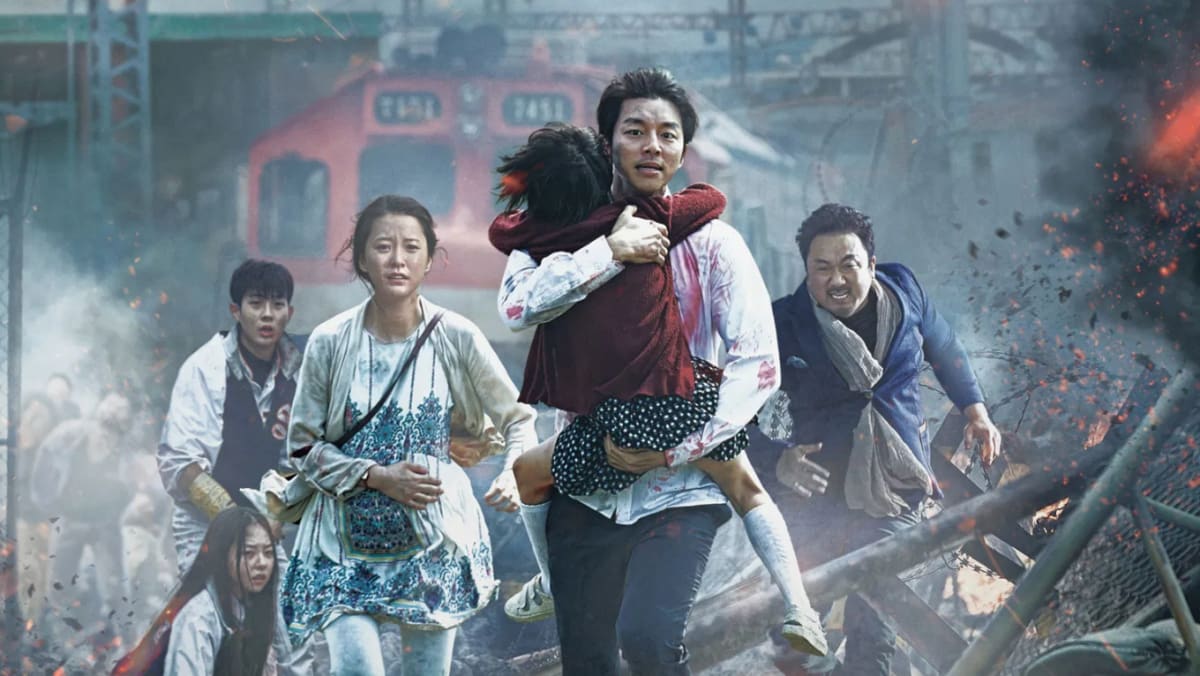
부산행 doesn't reinvent the zombie genre. It perfects a particular version of it — the contained-space survival thriller where the horror is partly the monsters and partly the people who respond to the monsters in ways that reveal character. What makes it Korean isn't the setting. It's what the film does with its contained space: a meticulous class analysis, delivered at full genre velocity, that arrives at its ending having earned the right to destroy you.
What the Film Is
석우 (Seok-woo) is a 펀드매니저 (fund manager) in 서울 (Seoul) — absent, distracted, a father who has forgotten his daughter's birthday. His daughter 수안 (Su-an) wants to visit her mother in 부산 (Busan). He agrees to take her. They board the KTX.
A zombie outbreak begins on the train.
What follows is a survival film set almost entirely aboard a 고속열차 (high-speed train) moving toward 부산, as passengers attempt to reach the uninfected cars and the sealed-off city ahead. The film is 118 minutes. It doesn't stop.
The Cast
Actor | Character | Note |
|---|---|---|
공유 (Gong Yoo) | 석우 | The absent father; K-Drama star whose performance here earned the film global attention |
김수안 (Kim Su-an) | 수안 | His daughter |
마동석 (Ma Dong-seok) | 상화 | A working-class husband protecting his pregnant wife; the film's most beloved character |
정유미 (Jung Yu-mi) | 성경 | 상화's pregnant wife |
김의성 (Kim Eui-sung) | 용석 | The corporate executive whose choices represent the film's class argument |
마동석 (known internationally as Don Lee) became a star in the West largely on the strength of this performance — his physicality and emotional warmth in the role of 상화 made him one of Korean cinema's most immediately recognizable exports.
The Class Argument
부산행 is a zombie film that is also, meticulously, a 계급 (class) film. The train's passengers are stratified from the moment they board — 비즈니스석 (business class) and 일반석 (economy), the powerful and the working people — and the zombie outbreak strips the social performance away to reveal what those class positions actually mean when survival is at stake.
용석, the corporate executive, is the film's clearest expression of this: a man who has spent his career protecting himself at the expense of others and who, during the outbreak, continues to do exactly this. His argument — I have to survive to take care of the people who depend on me — is the exact rationalization that every person who uses others for self-preservation tells themselves.
상화, by contrast — the 노동자 (blue-collar) husband — is the film's moral center. His actions throughout are straightforwardly protective of people he's just met, at consistent personal cost. His relationship with 석우, the self-interested fund manager, is the film's real emotional spine.
Tip — 엔딩: 부산행 earns its ending. The film has been building toward it from the first scene — a specific emotional debt that the script accumulates carefully and then collects with full force. If the ending doesn't hit you hard, go back and watch the opening scene again.
The Direction
연상호 (Yeon Sang-ho) directed 부산행 as his first live-action feature — he had previously made animated films, including the animated prequel 서울역 (Seoul Station, 2016) which tells the story of what was happening in 서울 at the beginning of the same outbreak. 서울역 is grimmer and more politically blunt; 부산행 channels the same anger into genre mechanics that reach a wider audience.
The train setting is the film's most important formal choice: a contained space with clear geography (the 객차 / cars have a specific order; moving from one end to the other means traversing the infected), a constantly changing velocity, and the specific physical logic of a KTX's narrow corridors and glass partitions.
The Reception
부산행 became the first Korean film to exceed 10 million domestic admissions in its release year, and its international performance established it as one of the most globally successful Korean films before 기생충. Released internationally through Well Go USA.
It revitalized global interest in zombie cinema — which had been commercially dominant (The Walking Dead, World War Z) but creatively exhausted — by bringing an emotional core and a class argument that the genre had mostly abandoned.
A sequel, 반도 (Peninsula, 2020), was released by 연상호. It is set in the same world four years after the original outbreak, with a new cast. It is primarily an action film rather than a character drama, and is generally considered a lesser work.
Key Facts
Director | 연상호 (Yeon Sang-ho) |
Year | 2016 |
Runtime | 118 minutes |
Language | Korean |
Genre | Horror / Thriller / Action |
Domestic admissions | 11.6 million |
Sequel | 반도 (Peninsula, 2020) — same world, different story |
Comments
Inappropriate comments may be deleted.
Log in to leave a comment.
No comments yet. Be the first!