
Slice-of-Life & Family Dramas (일상·가족 드라마)
No supernatural premise, no villain, no grand conspiracy — just people, in their lives, being honest about what that's like.
Slice-of-life and family drama is the K-Drama genre that requires the most patience and delivers the most lasting impression. There's no hook other than the characters and the specific texture of the world they inhabit. The stakes are ordinary — a job, a family dinner, a conversation that should have happened years ago — and the drama makes you feel that these ordinary stakes matter more than any plot twist could. Viewers who find the genre describe it as uniquely honest. Viewers who bounce off it describe it as slow. Both are accurate.
What the Genre Is
Slice-of-life and family drama in K-Drama covers a range of related forms:
일상 드라마 (daily life drama) — narratives built around ordinary existence: work, friendship, the small decisions that accumulate into a life.
가족 드라마 (family drama) — multi-generational or ensemble family narratives. Longer runs (sometimes 50+ episodes on weekend broadcast slots), slower pace, emphasis on relationship dynamics over plot mechanics.
직장 드라마 (workplace drama) — focused on professional life; the specific dynamics of Korean offices, hierarchies, and the social obligations of the workplace.
What distinguishes this genre from other K-Drama forms isn't the setting but the approach: these dramas are interested in character over plot, in texture over incident, in the slow accumulation of emotional truth over the quick deployment of genre satisfaction.
Essential Slice-of-Life and Family Dramas
Reply 1988 (응답하라 1988, 2015–2016)
Episodes: 20 | Network: tvN | Where to watch: Netflix
Five families living on the same alley in a Seoul neighborhood in 1988. The drama covers one year of their lives — the children growing up, the parents aging, the neighborhood's particular warmth before the country changed.
Reply 1988 is the most beloved K-Drama in Korea — consistently voted the best Korean drama of all time in domestic polls. Its appeal is specific and not fully translatable: a deeply Korean nostalgia for a particular era of communal living, before apartments replaced neighborhood, before smartphones replaced presence. International viewers who grew up in similar conditions — close neighborhood living, shared meals across households — find it resonant anyway.
The series has a signature mystery structure: the identity of the female lead's eventual husband is not revealed until the final episodes. This is a genuine dramatic device that generates significant fan investment. The "husband mystery" has become part of Korean drama culture.
Best for: Viewers who want the fullest K-Drama slice-of-life experience. The defining drama of the genre.
My Mister (나의 아저씨, 2018)
Episodes: 16 | Network: tvN | Where to watch: Netflix
A 30-something structural engineer whose life is quietly falling apart. A young woman living in extreme poverty with an enormous debt. Their unlikely connection forms at the office where they both work — not romantic, or not only romantic, but something that Korean has a word for: 정 (jeong), the deep attachment that comes from witnessing someone's life.
My Mister is not an easy watch. It's slow, it's heavy, and it withholds comfort for most of its run. What it offers is a portrait of how ordinary Korean working-class life actually looks and feels — the weight of debt, the specific exhaustion of men who were supposed to succeed and haven't, the specific survival calculus of a young woman who trusts no one because she can't afford to.
IU's performance is the finest of her career. Lee Sun-kyun's quiet devastation is the kind of acting that doesn't announce itself.
Tip — My Mister is not a romance: Multiple platforms and recommendation lists categorize My Mister as a romance. The central relationship has romance's emotional intensity but operates on different principles. Going in expecting conventional romantic resolution will lead to confusion and possible disappointment. Go in expecting something real, and it will deliver.
Best for: Viewers who want K-Drama's most honest and emotionally serious slice-of-life experience.
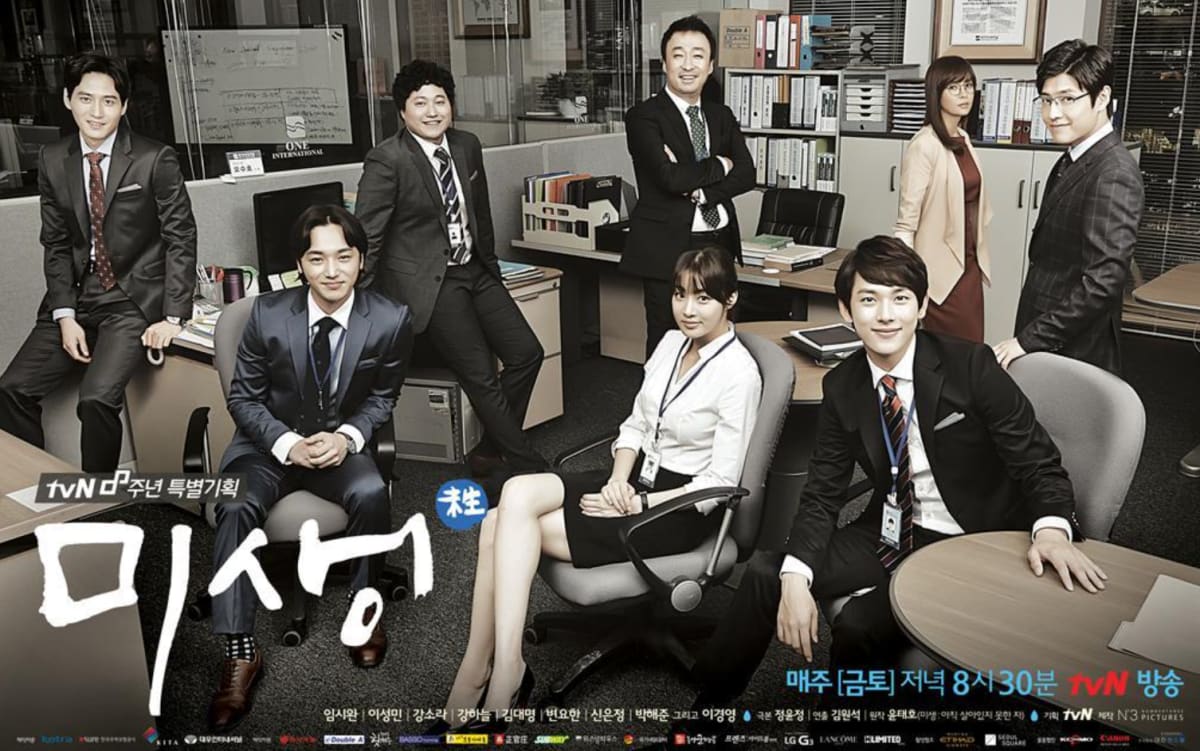
Misaeng (미생, 2014)
Episodes: 20 | Network: tvN | Where to watch: Viki
A young man who trained his entire life in baduk (Go) as a professional aspirant — and didn't make it — enters a trading company as an intern through a connection. Misaeng (literally "incomplete life") follows his first year in the corporate world with a documentary accuracy that earned it the reputation of the most honest Korean drama about office life ever made.
Based on a webtoon, Misaeng depicts the Korean workplace — its hierarchy, its 야근 (overtime culture), its demands for total loyalty, its specific cruelties and occasional warmths — with enough specificity that Korean office workers treated it as a mirror. Internationally, it's a genuinely valuable document of Korean corporate culture.
Best for: Viewers who want to understand what Korean work culture actually looks and feels like from inside.
My Liberation Notes (나의 해방일지, 2022)
Episodes: 16 | Network: JTBC | Where to watch: Netflix
Three adult siblings living in a rural suburb and commuting to Seoul every day, each quietly suffocating in their lives. The youngest sister starts a "Liberation Club" at work — a meeting where members commit to liberating themselves from whatever is trapping them. A mysterious man arrives in their village.
My Liberation Notes is the most recent drama on this list and the one most resonant for viewers in their twenties and thirties. It articulates something specific about the experience of modern Korean life — the distance between where you are and where you wanted to be, the specific loneliness of people who are fine by any objective measure but feel stuck — with unusual precision. Its final episodes are among the most emotionally affecting in recent Korean drama.
Best for: Viewers in their 20s–40s who want something that sees them.
Be Melodramatic (멜로가 체질, 2019)
Episodes: 16 | Network: JTBC | Where to watch: Viki, Netflix (some markets)
Three women in their early thirties navigating careers in the Korean television industry, romantic complications, and the specific experience of being a woman at exactly this age in Korea. Be Melodramatic is one of the few K-Dramas with a genuinely ensemble female perspective — three leads of roughly equal weight, each with a distinct arc and voice.
It's also funny in a way that Korean drama often isn't — dryly, observationally, with a meta-awareness of K-Drama conventions that never tips into parody.
Best for: Viewers who want female ensemble with warmth and wit.
The Weekend Family Drama Tradition
Korean television has a long tradition of weekend family dramas (주말 드라마) — 40–50 episode series airing on Saturday and Sunday, built around extended family dynamics across generations. These are the most Korean of K-Drama formats in some ways — built for a viewing habit where multiple generations watch together — and the least accessible internationally due to their length.
Notable exceptions: My Father Is Strange (아버지가 이상해, 2017) — 52 episodes, a family comedy-drama that became a domestic hit for its warmth and accessible humor.
Where to Start
If you want | Start with |
|---|---|
The most beloved, most Korean | Reply 1988 |
The most emotionally serious | My Mister |
Understanding Korean work culture | Misaeng |
Something contemporary and resonant | My Liberation Notes |
Female ensemble with humor | Be Melodramatic |
Comments
Inappropriate comments may be deleted.
Log in to leave a comment.
No comments yet. Be the first!