
Goryeo & Joseon (고려·조선): 500 Years of Dynasty
Two dynasties, one peninsula — and the laws, arts, and social codes that still shape Korean life today.
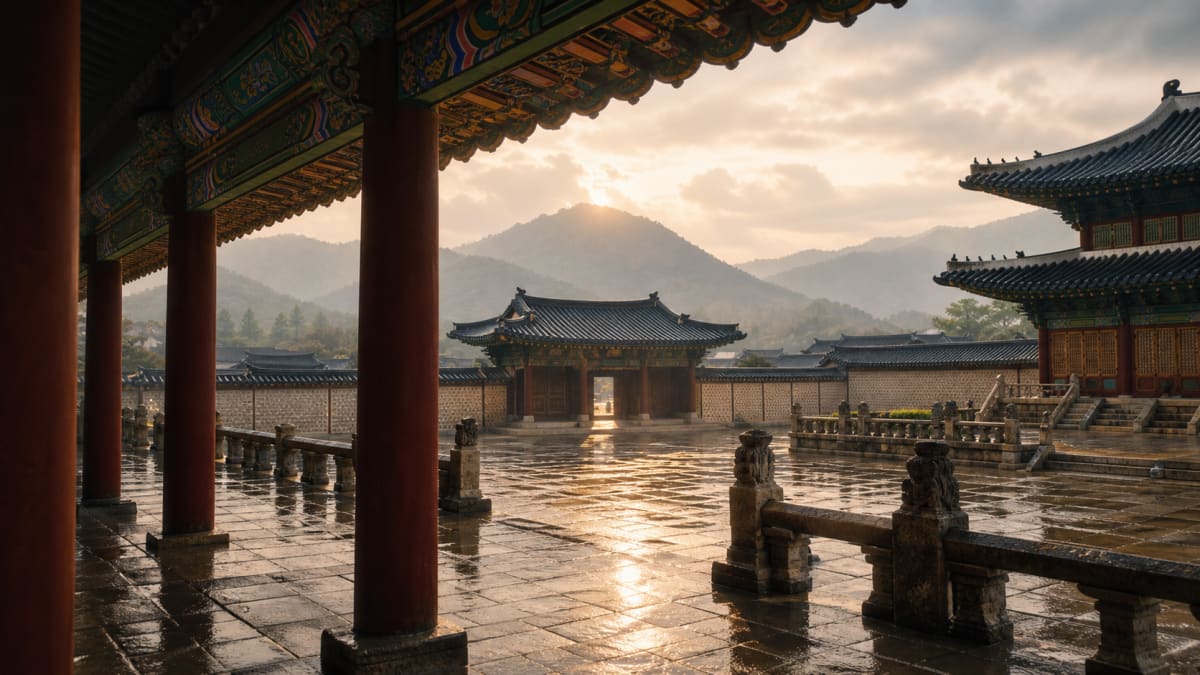
Most of what the world recognizes as distinctly Korean — the Confucian family structure, the civil service exam, celadon ceramics, the royal palace in Seoul — didn't come from ancient times. It came from two dynasties that governed the Korean peninsula for nearly a thousand years combined. 고려 (Goryeo) and 조선 (Joseon) are not just history. They are the architecture of modern Korean society.
고려 (Goryeo): 918–1392
코리아 (Korea) from 고려 (Goryeo)
고려 was founded in 918 CE by 왕건 (Wang Geon), a general who reunified the peninsula after the collapse of 통일신라 (Unified Silla). The name was a deliberate callback: 고려 is a shortened form of 고구려 (Goguryeo), the great northern kingdom. Wang Geon was signaling continuity — this was not a new start but a restoration.
The word Korea is a direct Western derivation of 고려. When Arab and Persian traders encountered the peninsula through maritime trade, they recorded it as Cauli or Corea — anglicized, eventually, into the name used worldwide today.
불교 (Buddhism) and the Arts
고려 was a Buddhist state, and its Buddhist culture produced two of the most remarkable achievements in Korean history.
The 팔만대장경 (Palman Daejanggyeong) — the Tripitaka Koreana — is a complete collection of Buddhist scriptures carved onto 81,258 wooden printing blocks, completed in the 13th century. It remains the most comprehensive and accurate version of the Buddhist canon in existence. The blocks are stored at 해인사 (Haeinsa) temple in South Gyeongsang Province and are a UNESCO World Heritage Site.
고려 celadon — 청자 (cheongja) — is among the most technically sophisticated ceramic work of the medieval world. Its distinctive jade-green glaze was admired across East Asia and has never been fully replicated.
몽골 침략 (Mongol Invasions)
고려's most severe test came in the 13th century. The Mongol Empire — then the largest land empire in history — invaded repeatedly from 1231 onward. 고려 relocated its court to 강화도 (Ganghwado) island and held out for decades, but the mainland was devastated. Eventually 고려 became a vassal state of the Mongol Yuan Dynasty, a subordinate relationship that lasted nearly a century.
The 팔만대장경 was created during this period — partly as a spiritual act of resistance, a prayer for protection against the Mongol threat.
Tip — 고려의 흔적 (Goryeo's traces): 고려's capital was 개경 (Gaekyeong) — present-day 개성 (Gaeseong), now in North Korea. The most accessible 고려 remains in South Korea are at 강화도, which served as the wartime capital during the Mongol invasions.
조선 (Joseon): 1392–1897
유교 국가의 탄생 (A Confucian State Is Born)
In 1392, a general named 이성계 (Yi Seonggye) overthrew the weakened 고려 court and founded 조선. The philosophical shift was as significant as the political one: 조선 replaced Buddhism with 유교 (Confucianism) as the state ideology — a change that restructured everything from government appointments to family ritual.
The 과거 (gwageo) — the civil service examination system — became the primary path to power and status. Mastery of Confucian classics, not birth or military skill alone, was the official basis for advancement. In practice, the system still favored the aristocratic 양반 (yangban) class, but the principle of merit-based selection embedded a particular relationship between education, status, and legitimacy that persists in Korean culture today.
세종대왕 (King Sejong) and 한글 (Hangeul)
조선's most consequential achievement came in 1443, when 세종대왕 (King Sejong the Great) commissioned and oversaw the creation of 한글 (Hangeul) — a phonetic writing system designed to be learned by ordinary people who had no access to the Chinese characters used by the elite.
The logic was direct: a population that cannot read cannot be governed well, and cannot govern itself. 한글 was revolutionary not just as a linguistic achievement — it is genuinely one of the most systematically designed writing systems ever created — but as a democratic act within a rigidly hierarchical society.
Tip — 한글의 과학 (The science of Hangeul): 한글 characters are not arbitrary. The consonants are designed to visually represent the position of the mouth and tongue when making each sound. ㄱ (g) reflects the back of the tongue against the throat. ㄴ (n) shows the tongue touching the roof of the mouth. It's a writing system built on phonetic logic — which is why linguists consider it among the world's most rational scripts.
임진왜란 (Imjin War): Japan's Invasion, 1592–1598
In 1592, 도요토미 히데요시 (Toyotomi Hideyoshi) launched a full-scale Japanese invasion of Korea — the 임진왜란 (Imjin War) — using the peninsula as a corridor toward China. The invasion was catastrophic. Japanese forces reached 한양 (Hanyang, present-day Seoul) within weeks. The devastation of the countryside, the destruction of cultural artifacts, and the forcible deportation of Korean artisans — particularly potters — left permanent marks.
The war's most celebrated figure is 이순신 (Admiral Yi Sun-sin), whose naval command repelled the Japanese fleet using 거북선 (geobukseon, turtle ships) — ironclad vessels whose design gave Korean forces a decisive tactical advantage. 이순신's military record — 23 battles, 23 victories — made him a national hero whose statue stands at the center of 광화문광장 (Gwanghwamun Square) in Seoul today.
조선의 쇠퇴 (Decline)
조선 endured for five centuries, but its final century was marked by internal faction, external pressure, and an inability to modernize fast enough to resist the imperial ambitions of its neighbors. The 19th century brought successive crises — forced trade treaties with Japan, internal peasant uprisings, and competing influence from China, Japan, Russia, and the United States. In 1897 조선 formally became the 대한제국 (Korean Empire), an attempt at modernization and sovereign assertion. It lasted 13 years before Japan annexed the peninsula in 1910.
Key Facts
고려 (Goryeo) | 918–1392 CE |
조선 (Joseon) | 1392–1897 CE |
수도 (Capitals) | 고려: 개경 (Gaekyeong) / 조선: 한양 (Hanyang, now Seoul) |
팔만대장경 | 81,258 woodblocks; UNESCO World Heritage Site |
한글 창제 | 1443 CE, commissioned by 세종대왕 |
임진왜란 | 1592–1598; Japanese invasion repelled with Chinese support |
대한제국 | 1897–1910; final sovereign Korean state before annexation |
Comments
Inappropriate comments may be deleted.
Log in to leave a comment.
No comments yet. Be the first!