
Real Estate (부동산): Rise, Crisis & Stabilization
Seoul apartments doubled in price in five years. Then the jeonse fraud crisis hit. Now a new government is trying to stabilize a market that has shaped — and distorted — Korean society for a generation.
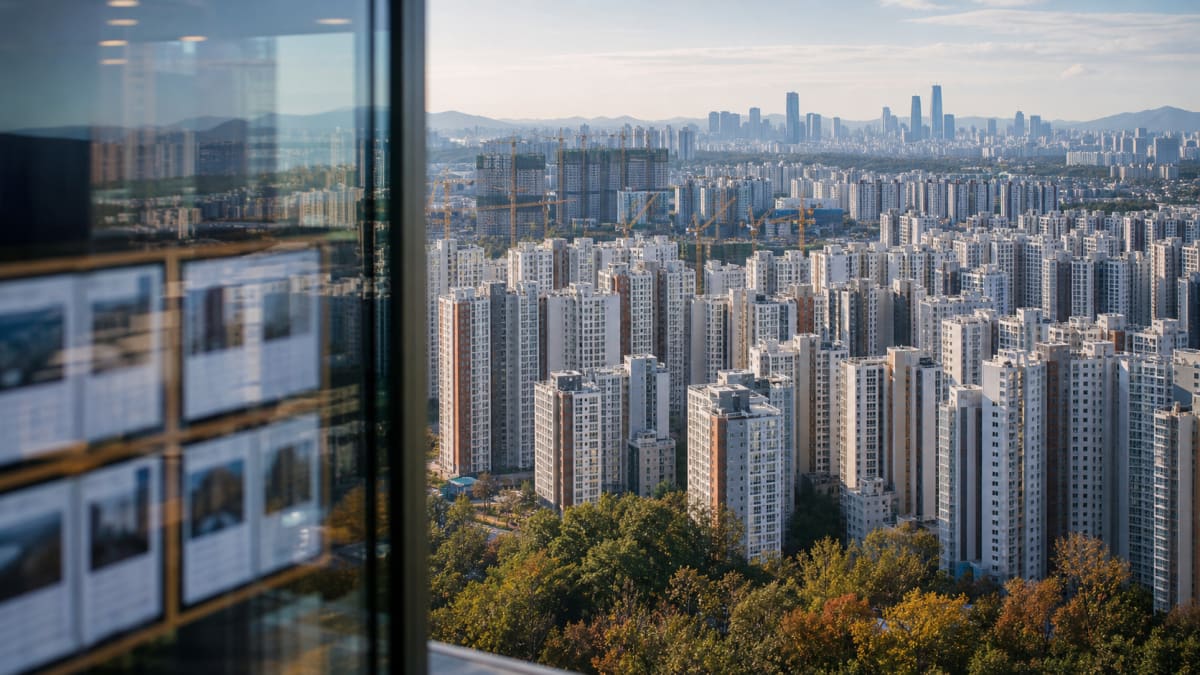
Korean real estate is not just an asset class. It is a social institution. Whether you own an apartment — and which apartment, in which neighborhood — determines school access, social status, and generational wealth transfer in ways that are more explicit in Korea than in most countries. The 아파트 (apartment) is the central unit of Korean middle-class aspiration, and the fluctuations in its value have produced political crises, personal disasters, and a generation of younger Koreans who have concluded that homeownership is no longer achievable.
한국 부동산 시장의 구조 (Structure of Korea's Real Estate Market)
아파트 중심 시장 (Apartment-Dominated Market)
Approximately 50% of Korean households live in apartments — large residential towers organized in complexes called 단지 (danji). The apartment market is:
표준화 (Standardized): Units are measured in 평 (pyeong) — 1 pyeong = 3.3㎡. Common sizes (25평, 33평, 42평) are widely understood benchmarks.
투명 (Transparent): All actual transaction prices are publicly registered and accessible at 국토교통부 실거래가 시스템 (Ministry of Land, Infrastructure and Transport actual transaction price system)
금융화 (Financialized): The 전세 (jeonse) system — in which tenants pay a large lump-sum deposit instead of monthly rent — transformed apartments into financial instruments as well as housing
지역별 격차 (Regional Disparities)
Seoul's real estate market operates in a different universe from most of Korea:
지역 (Region) | 아파트 평균 가격 (Average apartment price) |
|---|---|
서울 강남구 (Seoul Gangnam-gu) | ₩25억–₩50억+ |
서울 외곽 (Seoul outer districts) | ₩6억–₩12억 |
부산 (Busan) | ₩3억–₩7억 |
대전·대구·광주 | ₩2억–₩5억 |
지방 중소도시 (Regional small cities) | ₩1억–₩3억 |
The 강남–지방 gap is not just a price difference — it reflects a concentration of educational, employment, and infrastructure access that makes 강남 real estate a proxy for life opportunity.
상승의 역사 (The Rise)
Seoul apartment prices rose approximately 80–100% between 2017 and 2021 — one of the fastest appreciations of a major city's housing market in OECD history.
상승 원인 (Causes of the rise):
저금리 (Low interest rates): The post-2008 global low interest rate environment made real estate debt cheap. Korean mortgage rates fell to historic lows, expanding the pool of leveraged buyers.
공급 부족 (Supply shortage): 문재인 government's initial housing policy restricted apartment supply in key Seoul districts through strengthened development regulations — based on a theory that supply restrictions would reduce speculation. The opposite occurred: restricted supply with rising demand produced price escalation.
갭투자 (Gap investment): The 전세 system created a specific investment mechanism — 갭투자 (gaep tuja, gap investment) — in which investors would purchase an apartment, rent it out on 전세, use the tenant's deposit as the purchase financing, and profit from price appreciation with minimal cash down. At low price-to-전세 deposit ratios, this was effectively leveraged real estate speculation at near-zero cost.
다주택자 급증 (Multiple property owners): The combination of low rates, 갭투자, and expectations of continued appreciation drove rapid growth in 다주택자 (multiple property owners) — households owning 2, 3, or more apartments as investment vehicles.
위기 — 전세 사기와 금리 인상 (The Crisis)
The 2022 interest rate normalization — as central banks globally raised rates to combat inflation — hit Korea's real estate market in a specific and devastating way.
금리 인상의 충격 (Rate rise impact): As interest rates rose, the return available on investment alternatives exceeded what landlords could earn by holding 전세 deposits. Landlords who had borrowed against 전세 deposits to purchase additional properties found their models breaking down. Property prices began falling — and with them, the ability to return 전세 deposits to departing tenants.
전세 사기 위기 (Jeonse fraud crisis): The crisis that emerged in 2022–2023 was one of the most significant housing disasters in Korean history. Thousands of tenants — particularly younger, less experienced renters — found that their landlords could not return their 전세 deposits:
Landlords had used deposits to purchase multiple properties (갭투자)
Property values had fallen below the combined mortgage + 전세 deposit
Landlords declared insolvency or simply disappeared
Estimated losses: approximately ₩3–5 trillion — tens of thousands of households, many of whom had saved for years to accumulate a 전세 deposit that vanished.
Tip — 전세 사기 예방 (Preventing 전세 fraud): The government introduced strengthened protections post-crisis: mandatory disclosure of existing mortgages before signing, enhanced 전세보증보험 (HUG deposit insurance) requirements, and priority registration rules. For anyone considering a 전세 arrangement: always verify the property's 등기부등본 (real estate registry), ensure total mortgage + your deposit does not exceed 70–80% of property market value, and obtain 전세보증보험. These steps are not optional; they are essential.
안정화 추세 (The Stabilization)
From the 2022 peak, Seoul apartment prices fell approximately 20–30% through 2023 — the largest correction since the 2008 global financial crisis.
이재명 정부의 부동산 정책 (Lee Jae-myung government's policy):
The 이재명 government that took office in 2025 has emphasized housing supply expansion and market stabilization rather than the demand-side restriction policies that characterized parts of the 문재인 era:
재건축·재개발 규제 완화 (Redevelopment deregulation): Easing restrictions on apartment complex redevelopment — particularly in older Seoul neighborhoods — to increase supply
3기 신도시 공급 가속 (3rd new town acceleration): Speeding delivery of planned new towns (하남, 과천, 인천 계양 등) to increase housing supply in the greater Seoul area
청년 주거 지원 (Youth housing support): Expanded youth-targeted housing programs — low-interest mortgages, public rental housing — to address the most acute housing access problem
시장 상황 (Market situation as of 2025–2026): Seoul apartment prices have shown gradual stabilization and modest recovery from 2023 lows — particularly in 강남 and other premium districts. The broader market remains subdued. The combination of higher interest rates (relative to the 2020–2021 lows), demographic headwinds (declining household formation), and policy supply expansion suggests a structural moderation rather than a return to 2017–2021 price acceleration dynamics.
외국인의 한국 부동산 투자 (Foreign Investment in Korean Real Estate)
Foreigners can legally purchase real estate in Korea — including apartments — with some administrative requirements:
Acquisition must be reported to the 한국은행 (Bank of Korea) within 60 days
Purchase in designated 토지거래허가구역 (land transaction permit zones — including most of 강남) requires prior permit approval
No restriction on foreign ownership of apartments as a general rule
실용적 고려사항 (Practical considerations): Foreign buyers without permanent residency or F-series visa status face mortgage access limitations — Korean banks typically require domestic credit history and stable income documentation. The 전세 system is also available to foreign landlords.
Key Facts
아파트 거주 비율 (Apartment residence rate) | Approximately 50% of Korean households |
서울 가격 상승 (Seoul price rise) | Approximately 80–100% between 2017 and 2021 |
2022–2023 조정 (2022–2023 correction) | Seoul apartments fell approximately 20–30% from 2022 peak |
전세 사기 피해 (Jeonse fraud losses) | Estimated ₩3–5 trillion — thousands of households affected (2022–2023) |
갭투자 (Gap investment) | Leveraged apartment purchase using 전세 deposit as financing — primary speculation mechanism |
실거래가 조회 (Transaction price lookup) | 국토교통부 실거래가 시스템 — all Korean property transactions publicly registered |
외국인 취득 신고 (Foreign purchase reporting) | Must report to 한국은행 within 60 days of acquisition |
전세보증보험 (Jeonse deposit insurance) | 주택도시보증공사 (HUG) — essential protection for all 전세 arrangements |
Comments
Inappropriate comments may be deleted.
Log in to leave a comment.
No comments yet. Be the first!